



05 de November de 2026
Dinamización rural
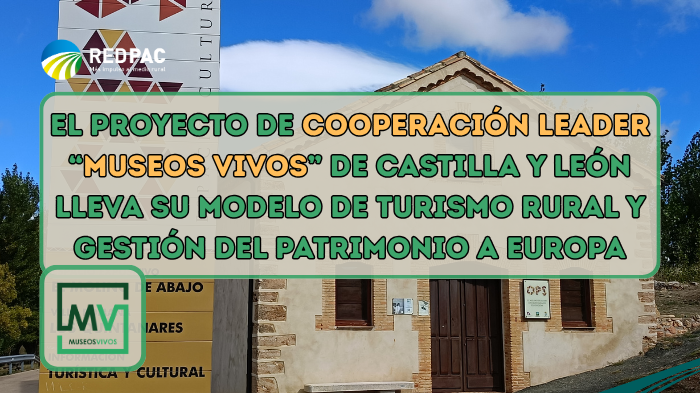
The LEADER Living Museums cooperation project presented its model for the smart opening of rural museums in Soria to local action groups from four European countries.
Last October, the Local Action Groups of Castile and León organized a meeting with groups from Italy, Romania, Portugal, and Bulgaria to present the museum opening system.
The Living Museums network was created in 2018 and currently has more than 100 open spaces in Spain and one in the Czech Republic
The LEADER cooperation project “ Living Museums ” brought together the Local Action Groups (LAGs) of Castile and León in 2018 with the aim of reopening museum and cultural spaces that had disappeared in small towns. To achieve this, they developed a smart access system that allows visitors to enter independently by making a prior reservation online, at any date and time.
In this way, the GALs formed a network of museums, which was later joined by two spaces in Galicia and one in the Czech Republic. Other European countries also expressed interest in adapting this technology to their heritage, and last October they held an international meeting to learn about and implement this system.
Marisa Muñoz, manager of ADEMA , pointed out that the fact that this project has attracted international attention means that the GALs have had a good idea that can be transferred to other places.
LEADER to boost European heritage
The event took place between October 6th and 8th in Soria and brought together fifty representatives from the 18 Local Action Groups (LAGs) of Castile and León and ten others from Europe (five from Italy, two from Romania, two from Portugal, and one from Bulgaria) to promote the initiative and establish joint working relationships. During the meeting, they visited six museums and the historical heritage sites of the participating municipalities. David Fongoli, from the Valle Umbra LAG in Italy, noted that it had been very interesting “to learn about different museum spaces and how to implement the system because, for us, this is the beginning of our ‘Cultura Porte Aperte’ project.”
The international Local Action Groups (LAGs) also highlighted their interest in networking, the smart web-based access system, visitor management, and museum security. “We have very similar heritage and want to implement something similar,” added the representative from the Beira Douro LAG (Portugal).
More than 100 open cultural spaces
“Living Museums” has a web platform where reservations are made and which compiles information, brochures, and audio guides for the museums. Using the smart system , the reservation generates a code that visitors use to open the museum for 30 minutes or an hour. This initiative has not only kept small museums open but has also revitalized other emblematic buildings such as castles, towers, palaces, and churches at a low cost, making it affordable for any location with limited resources. The system also tracks the number of visitors received: across the 103 sites in Castile and León, approximately 400,000 have been recorded so far.
José Luis Alonso, manager of ASOPIVA and one of the organizers, explained that “the most important thing is for groups coming from outside Spain to see what we've implemented. Infrastructures that were once abandoned and closed are now open to visitors, accessible to anyone who wants to see and learn about the culture and heritage.” He added, “There are projects developed with European funding at the national level that then don't continue. This one, however, has a tremendous connection to the region. And we can measure the results by the number of visitors we receive. It's spectacular.”
Participants and funding
During its first phase (2018-2022), “Living Museums,” coordinated by ADRI Valladolid Norte , involved 15 Local Action Groups (LAGs) from Castile and León. Developed through the LEADER program within the 2014-2022 Rural Development Programme (RDP) of Castile and León, the project was co-financed 80% by the European Agricultural Fund for Rural Development (EAFRD) , 14% by the Regional Government of Castile and León , and 6% by the Spanish Ministry of Agriculture, Fisheries and Food.
This meeting was framed within the LEADER cooperation projects “Cultural Identity” and “Living Museums+”, in which 18 Castilian-Leonese LAGs participate in collaboration with other territories.