





17 de July de 2026
Cambio climático y gestión de recursos naturales
Calidad y cadena alimentaria
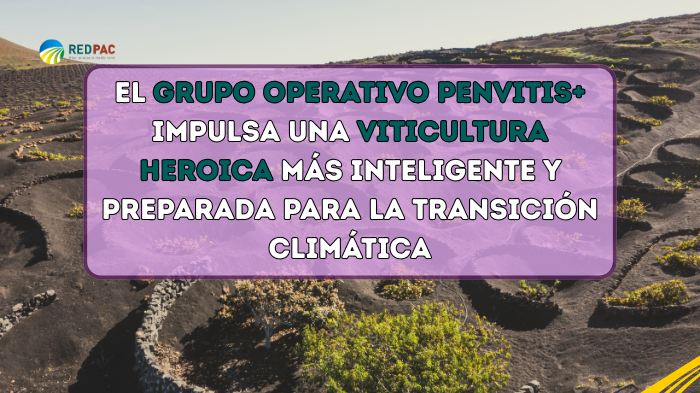
The PENVITIS+ Operational Group is investigating tools based on artificial intelligence, drones and regenerative practices to improve the management of vineyards on steep slopes
- The PENVITIS+ Operational Group is investigating tools based on artificial intelligence, drones and regenerative practices to improve the management of vineyards on steep slopes
- The initiative seeks to reduce the effects of heatstroke, optimize the use of pesticides and facilitate work on farms in Galicia, the Canary Islands and Catalonia
- PENVITIS+ seeks to promote knowledge transfer so that the solutions developed can be replicated in other wine-growing regions.
Viticulture on steep slopes , known as heroic viticulture, is a model of cultivation with great landscape, economic, and cultural value. However, these vineyards face significant challenges related to climate change, the difficulty of mechanizing agricultural tasks, the pressure of pests and diseases, and a lack of generational succession. Adapting to this scenario is essential to guarantee their viability and preserve an activity closely linked to the development of numerous rural areas.
With this objective, the PENVITIS+ Operational Group (OG) was created , an initiative that aims to combine innovative agronomic practices with digital technologies to improve the resilience of vineyards on steep slopes. The project will develop solutions based on artificial intelligence (AI), drones, and regenerative strategies to improve grape quality, optimize decision-making, and facilitate the work of winegrowers in Galicia, the Canary Islands, and Catalonia.
A response to the challenges of heroic viticulture
PENVITIS+ was created to offer solutions adapted to the particularities of heroic viticulture , where steep slopes hinder mechanization and cause the effects of climate change to have a greater impact on farms.
As Xavier París, head of the technical office of the INNOVI coordinating group , explains, “heroic viticulture should not be seen as a relic of the past, but as a productive system with a future if it is provided with the right tools.” He also emphasizes that preserving these vineyards means maintaining the landscape, preventing the abandonment of the land, and supporting rural economies linked to this unique form of cultivation. The project's main objectives include:
Study and implement innovative winemaking practices adapted to steeply sloping vineyards.
Improve crop resilience to climate change .
To promote a more balanced ripening of the grapes and reduce damage caused by heat stress.
Promote the transfer of knowledge to winegrowers, wineries, designations of origin and technology centers.
Artificial intelligence, drones and regenerative practices at the service of the vineyard
One of the pillars of PENVITIS+ is the incorporation of technologies that allow for more efficient and safe vineyard management. To this end, the GO is studying predictive models based on artificial intelligence, monitoring tools, and automated solutions adapted to farms where conventional mechanization is very limited. The main lines of work include:
Validation of agronomic practices to protect the bunch against high temperatures.
Development of predictive models that allow anticipating pests and diseases.
Integration of climate, agronomic and field data to improve vegetation and soil management.
In the words of Xavier París, “the innovation proposed by the project does not seek to replace the winegrower's knowledge, but to expand it. Data, AI, robotics, and regenerative practices only make sense if they help to make better decisions and make daily work more viable.”
Expected results for a more competitive sector
Although the project has just begun and final results are not yet available, it already has a structured work plan and clearly defined technical objectives for the upcoming wine-growing seasons. The aim is to obtain easily applicable solutions that will help improve the competitiveness of farms. The main expected results include:
Reduce the effects of heat stress on grape ripening.
Improve the balance between alcohol content, acidity, freshness and pH.
Reducing the use of plant protection products through predictive models.
Reducing the time spent on manual tasks through automation and the use of drones.
To facilitate more efficient and safe management of vineyards located on hillsides.
In addition, the GO will promote technical workshops, reports and informational materials so that the solutions developed can be used by other professionals and adapted to different regions with similar characteristics.
Participants and funding
The GO PENVITIS+ is coordinated by the Associació AEI INNOVI and its beneficiary entities are:
Furthermore, it involves the participation of research organizations, public administrations, and specialized entities. The project is supra-regional in scope, will be developed between 2025 and 2029 in Galicia, the Canary Islands, and Catalonia, and has a budget of €599,239 , co-financed 80% by the European Agricultural Fund for Rural Development (EAFRD) , within the framework of the CAP Strategic Plan (PEPAC) 2023-2027 .